

- All
- Case Studies in Neurocritical Care AI
- Brain Matters

A continuous convolutional neural network: very early EEG most predictive for poor neurological outcome in postanoxic coma
Inayah Hodžić, AI Researcher at the Department of Neurology at the Amsterdam University Medical Center (Amsterdam UMC), presents a deep learning model for continuous neurological outcome prediction in patients with postanoxic coma.
Possibilities, Liabilities, and Concerns: Confessions of an AI Skeptic
Dr. Claude Hemphill, Professor of Neurology and Neurological Surgery at the University of California, San Francisco and Chief of Neurology and Director of Neurocritical Care at Zuckerberg San Francisco General Hospital, shares his perspectives on the implementation of AI in neurocritical care beyond experts and researchers.
Characterizing the Physiology of Circulatory Arrest in Humans
Dr. Mypinder Sekhon presents a multi-pronged approach for the physiology of the circulatory arrest in humans, to understand the processes that underpin death determination and cerebral ischemia.
Personalizing the Pressure Reactivity Index for Quantifying Cerebral Autoregulation in Neurocritical Care
Jennifer Briggs presents a personalized approach to the Pressure Reactivity Index (PRx) for quantifying cerebral autoregulation. Her work improves the accuracy and reliability of PRx by accounting for patient-specific variability and algorithmic sensitivity, advancing clinical decision-making in neurocritical care.
A Novel Methodology for Intracranial Pressure Subpeak Identification
Xu Han, in collaboration with mentors at the University of Cincinnati, presents a new method for identifying subpeaks in intracranial pressure (ICP) waveforms in traumatic brain injury patients. His work improves visualization and computational efficiency, enabling real-time analysis and better patient monitoring.
Automated Detection of Spreading Depolarizations in Electrocorticography
Jed Hartings and Sreekar Puchala explore real-time, automated detection of spreading depolarizations in electrocorticography, highlighting the potential of algorithmic monitoring to enhance clinical adoption, reduce reliance on manual review, and offer new insights into SD waveforms through systematic, cloud-based analysis.
Body, Brain, Behavior: Non-Invasive Neurotechnologies for Peak Performance and Cerebral Health
Jana Kainerstorfer explores non-invasive neurotechnologies for brain health, highlighting near-infrared optical imaging with EEG for disease monitoring, performance optimization, and applications in clinical and extreme environments.
EEG Signal Processing and Machine Learning for Coma Recovery Prediction in Critical Care
Dr. Morteza Zabihi examines recent approaches developed for EEG analysis in critical care, discusses key challenges of applying machine learning in healthcare, and explores strategies for building trustworthy, robust AI models.
WAVEFRONT: Noninvasive, Automated Detection of Cortical Spreading Depolarizations Using Scalp EEG
Dr. Alireza Chamanzar & John McNamee from Precision Neuroscopics discuss WAVEFRONT, allowing users to review detections, temporal and spatial signal patterns, propagation speed, and CSD frequency over time.
Predicting the Trajectory of ICP in TBI Patients: Evaluation of a Foundation Model for Time Series
Florian van Leeuwen explores whether pre-trained (foundation) models, leveraging the power of transfer learning, hold the key to predicting intracranial pressure changes in TBI patients.
Automated Artifact Detection for ABP Data From Heuristics to Deep Neural Networks
Tony Okeke explores innovative approaches to identifying artifacts in arterial blood pressure (ABP) data using a variety of machine learning techniques.

NCC Big Data Analysis: Is Unsupervised Clustering a Solution?
Jeanette Tas provides an overview of how unsupervised clustering, which uncovers new data patterns, has been applied to the field of neurocritical care.
Using Deep Learning to Analyze the Intracranial Pressure Signal in Traumatic Brain Injury Patients
Dr. Agnieszka Kazimierska and Cyprian Mataczyński showcase their deep learning-based approach for analyzing intracranial pressure (ICP) pulse waveform morphology and predicting potentially life-threatening episodes of elevated ICP.
COIN: A Novel qEEG Index to Detect Stroke and Cerebral Ischemia
Dr. Caffarelli discusses barriers to broad use of EEG for stroke screening and introduces the COIN index, providing an intuitive threshold-based readout of focal power suppression associated with stroke.
An Approach to Visualize and Detect Features of Brain Injury Progression
Dr. Balança & Dr. Ghibaudo explore how to visualize and analyze the interplay between markers of cortical injury such as cortical spreading depolarization and subcortical impairment such as heart rate and respiratory rate variability.
Multicenter ICU EEG Collaboration: Opportunities & Pitfalls
Dr. Amorim discusses his experience developing the International Cardiac Arrest Research (I-CARE) consortium, a multicenter EEG database of 1,000+ patients with coma post-cardiac arrest. He reviews challenges in EEG data harmonization and algorithm deployment as well as discuss the experience of releasing this dataset to the 2023 George B. Moody Physionet Challenge.
A Data-Driven Disease Course of TBI: Mining Prognostic Trajectories from ICU Data
Shubhayu speaks on integrating heterogeneous medical record data to model how clinical course influences 6-month GOSE outcomes. Using a prospective TBI cohort, he trains recurrent neural networks to predict ordinal GOSE scores every 2 hours from a token-embedded time series, incorporating missing values. His approach converts large patient records into interpretable time series with minimal processing.
Beta Oscillations & Traveling Waves With Recovery From TBI
Dr. Vaz covers the return of intracranial beta oscillations and traveling waves with recovery from traumatic brain injury.
Predicting 6-Month GOS-E from ICP and Brain Oxygenation
Ethan Moyer demonstrates a few techniques for predicting GOS-E outcomes on the BOOST II patients using Python.
Data Exploration through Multimodal Animation
Dr. Ramon Diaz-Arrastia speaks on his experience as a leader in TBI research and how analytics and big data can advance his work into the future.

Structuring Unstructured Data
Professor Ed Kim from Drexel University’s College of Computing and Informatics brings us up to speed on the background to modern AI, machine learning, and deep learning methods.

The Groundwork for Multimodal Machine Learning
Professor Ed Kim from Drexel University’s College of Computing and Informatics brings us up to speed on the background to modern AI, machine learning, and deep learning methods.
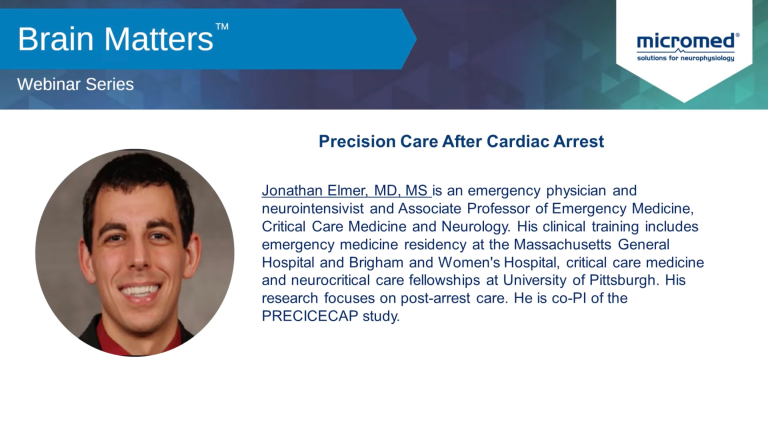
Precision Care After Cardiac Arrest
Jonathan Elmer discusses limitations in current neuro-prognostication tools, post-arrest prognostication and precision medicine, and high resolution multimodal data for precision care after cardiac arrest – the PRECICECAP study.
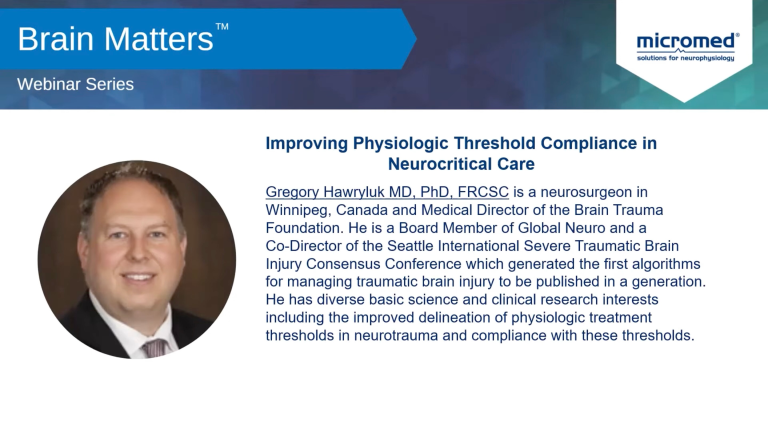
Improving Physiologic Threshold Compliance in Neurocritical Care
Gregory Hawryluk discusses concerns with poor threshold compliance in neurocritical care, the rationale for improving physiologic threshold compliance, and appreciation of a tool developed to improve physiologic threshold compliance and evidence supporting its effectiveness.
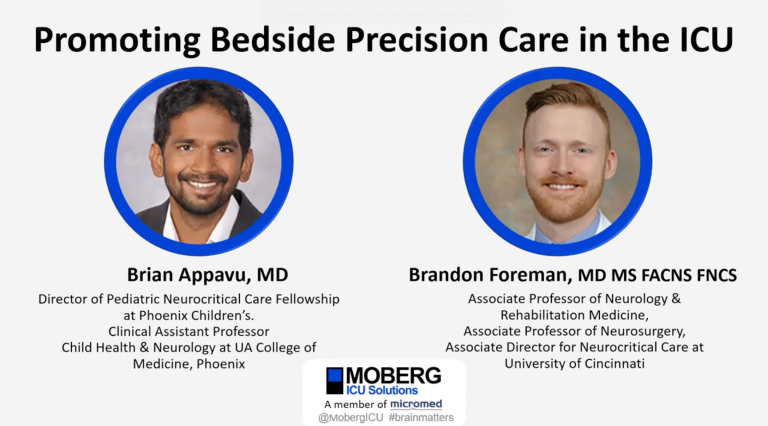
Promoting Bedside Precision Care in the ICU
Brian Appavu and Brandon Foreman explore recent work describing the interpretation and reporting of MMM (Multimodal Monitoring) data in the pediatric ICU and its impact on care, the value of interpreting and reporting MMM data to clinical teams, the practical aspects of reporting MMM data in clinical practice, and future directions to enhance the utility of MMM to improve patient care.
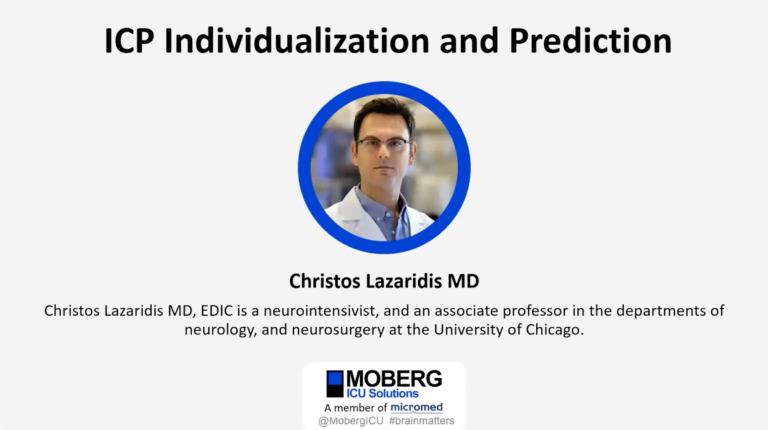
ICP Individualization and Prediction
Christon Lazaridus covers conceptual approaches to intracranial hypertension, patient-specific intracranial pressure, and predicting secondary brain insults.

The Pathophysiology of Acute Brain Damage
Dr. Luca Longhi talks on characteristics of traumatic brain injury and subarachnoid hemorrhage and preliminary data collected through the CNS Monitor.
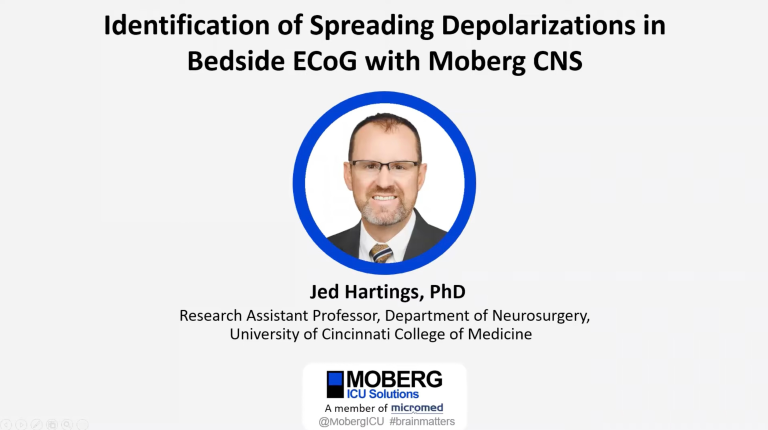
Identification of Spreading Depolarizations in Bedside ECoG with Moberg CNS
Jed Hartings covers methods for recording spreading depolarizations, characteristics of spreading depolarizations, and using Moberg software to help identify spreading depolarizations.
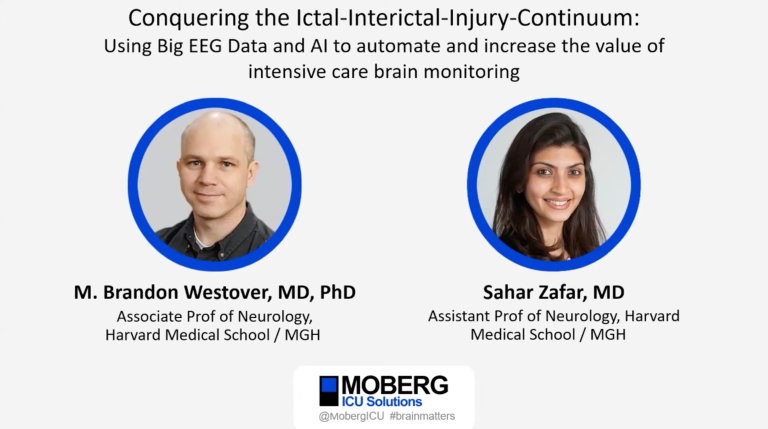
Conquering the Ictal-Interictal-Injury-Continuum: Using Big EEG Data and AI to automate and increase the value of intensive care brain monitoring
Brandon Westover and Sahar Zafar discuss using Ictal-Interictal Continuum Abnormality (IICA) burden to predict patient outcome, automating detection of seizure and IICA, and areas of the model needing improvement.
Butterflies in the Brain - Emerging applications of NeuroUltrasound in ICU
Dr. Sarwal gives a case-based talk on emerging clinical application of neuroultrasound in the critical care setting. Clinical cases highlighting the use of cranial ultrasound and point of care applications of transcranial doppler monitoring in enhancing the understanding of patient’s cerebrovascular physiology are reviewed.
Perspectives on (Non) Invasive ICP Monitoring
Dr. Heldt provides a review of some important concepts when monitoring ICP. He also gives an overview of research in recording this important cranial vital sign non-invasively. Learn about The Integrative Neuromonitoring and Critical Care Informatics Group. http://neuro.mit.edu/
The Neuro ICU Cockpit
This month’s webinar takes you to Zurich, Switzerland where you will hear about the Neuro ICU Cockpit developed by Dr. Emanuela Keller together with ETH Zurich and IBM Research Zurich. Their ICU Cockpit is a great example of how to use comprehensive data for predicting status and optimizing patient management.
Spinal Cord Perfusion Pressure: A New Protocol for Hemodynamic Management of SCI
Lawrence Chyall and Debra Hemmerle discuss recent findings from the CAMPER study which demonstrate that maintaining SCPP greater than 50mmHg is a strong predictor of recovery in spinal cord injury (SCI). They present a new protocol that operationalizes these findings into the clinical practice of a Smart Neuro ICU. Dr. Geoff Manley makes a guest appearance to introduce the topic.
Improving outcomes in neonatal asphyxia: New Frontiers of Real Time Neuromonitoring Towards Precision Based Therapies
Dr. Lina Chalak discusses the topic of neonatal asphyxia. The session includes challenges and updates for infants with so called “mild HIE”, new research involving physiological biomarkers to improve risk stratification of the disease severity within 6 hours, as well as new randomized trials of neuroprotection beyond hypothermia.

Physiology Based Management of TBI: Challenges to Guide Therapy
Clinical management of severe traumatic brain injury has traditionally been focused on control of intracranial pressure, which may be an insensitive and late indicator of secondary brain injury. The monitoring and treating of other physiologic variables, particularly brain tissue oxygenation (PbtO2), may enhance patient care. Insights regarding physiological changes in the brain may be determined through responses of PbtO2 to controlled changes in FiO2, CO2 and MAP. The methods to perform and interpret these dynamic “challenges” are the focus of this webinar.
Spreading Depolarizations in the Injured Human Brain: Characterization, Clinical Significance and Implications for Neuromonitoring
Sharon Jewell discusses what Spreading Depolarizations (SD) are, how to record them, and why they are clinically relevant in the context of human brain injury. She covers the electrical characteristics of SDs, the blood flow response, and the complex interactions that SDs share with other, established secondary insults. She also touches upon their discovery and historical aspects of SDs important for our current and future understanding.
The Brain Oxygen Optimization in Severe TBI (BOOST) Phase 3 study: Towards evidence based medicine in the neurological ICU
Dr. Ramon Diaz-Arrastia, MD, PhD, from the University of Pennsylvania, presents the scientific and clinical rationale for monitoring brain tissue oxygen pressure, summarizes the results of the BOOST Phase 2 study, and discusses the design of the BOOST Phase 3 study, which will be launched in the first quarter of 2019.
Electroencephalographic Patterns in Neurocritical Care
Dr. Brian Appavu, MD discusses electroencephalographic patterns in neurocritical care as epiphenomena or direct contributors of brain injury. He highlights the effect that seizures and other EEG patterns may have on other neurophysiologic variables (ABP, CPP, brain tissue oxygenation, etc).
Continuous Assessment of Cerebral Autoregulation in TBI Patients Using ICM+
Dr. Peter Smielewski of Cambridge Neuroscience presents the current state of the art in continuous assessment of cerebral autoregulation in patients undergoing neuro-monitoring. In particular, he illustrates a practical approach to the autoregulation-oriented management of TBI patients and discusses the clinical impact of such therapy and the road ahead.
Interpreting and Reporting Multimodal Neuromonitoring Data: A Medical Record for the Brain
Dr. Brandon Foreman, MD, FACNS demonstrates how he records multimodal data and uses this new “medical record for the brain” in the management of his patients.

Unraveling the complexities of invasive multimodality neuromonitoring
Dr. Ramani Balu, MD, PhD discusses his recent publication and Olof Nord, discusses the present and future of cerebral microdialysis. Topics covered in this webinar are invasive neuromonitoring methods, candidates for invasive monitoring, and benefits of utilizing multiple monitors.

Bedside Brain Monitoring in the NICU
The first webinar of our Brain Matters Webinar series is on neonatal brain monitoring, featuring Kathi Salley Randall, RN, MSN, CNS, NNP-BC. Topics covered in this webinar are advantages and disadvantages of cEEG and aEEG, usage of therapeutic hypothermia in neonates, and benefits of multimodal monitoring in neonatal care.